
 Learning to listen to your own system before it has to get louder
Listen Now! Apple | Spotify | Youtube
You are your own best doctor, and most of us were never taught that.
One of the most important things I have come to believe, both in my own life and in years of practice, is that the person most qualified to understand what is happening in your body is you. You are the one living in it. You are the one experiencing your life. And your life and what your body is going through are far more connected than most of us were ever taught to recognize.
Most of us were not raised to look at what was happening in our internal or external world when a symptom appeared. We were taught to treat the symptom, manage it, suppress it, and move on. And while there is absolutely a time and a place for medical intervention, what tends to get skipped entirely is the more useful question: why is this showing up right now, and what else was happening when it did?
That is what this conversation is really about.
What the mind-body connection actually means for your health.
The body is not only a physical structure. It is processing mental, emotional, chemical, and even spiritual experiences simultaneously. And when something in those layers is not being addressed, when it is being pushed down, ignored, or carried without acknowledgment, the body tends to find a place to store it.
Learning to see that connection is a significant paradigm shift for most people. We are not generally taught in a Western medical model to ask, “What else was going on when this started?” or to look at a person’s whole life story alongside what is showing up physically. But when you start to look there, the connections tend to be hard to unsee.
A resource I come back to again and again, and one we hand out in the office regularly, is You Can Heal Your Life by Louise Hay. The back of the book has a remarkable reference guide that maps different areas of the body to corresponding mental and emotional patterns. Once you start reading it, it reframes how you think about recurring symptoms entirely.
A few examples of how this shows up in the body:
- Lower back pain often connects to feeling unsupported, or to feeling like you are the one holding everyone else up
- Upper back and shoulder tension frequently corresponds to carrying a heavy load, real or perceived
- Gut issues can reflect what a person is struggling to process, emotionally as much as physically
- Neck stiffness and limited range of motion can relate to flexibility of perspective and resistance to seeing things differently
- Heart-related symptoms often connect to how openly love and energy are moving through a person’s life
This is not a way of dismissing what is happening physically. The physical experience is completely real. The point is that when we focus only on the physical layer, we miss a significant part of what the body is actually responding to.
A story from practice that makes this real
A practice member who had been coming in regularly for years walked in one day, noticeably tilted to one side. Her lower back had gone out badly enough that she was walking at an angle, and when I asked what she thought had caused it, she genuinely could not think of anything physical. She hadn’t lifted anything, hadn’t done anything unusual.
When we dug a little deeper, she shared that her adult son had just moved back home and had brought his girlfriend with him. She was suddenly responsible for feeding two extra people and felt completely overwhelmed by it.
When you look at the mental and emotional connection to the lower back in Louise Hay’s work, it maps directly to feeling unsupported, or feeling like you are the sole support for everyone around you. Her body was not misfiring. It was being completely literal about what she was carrying, and once she could see that connection, it opened up a very different conversation about what actually needed to shift.
What happens when we override what the body is trying to communicate?
The body tends to start with something subtle. A little tension in a familiar spot, something that feels slightly off but easy enough to push through. When that signal does not get acknowledged, it gets more persistent.
This is something I experienced personally. About a year and a half ago, during a season of a lot of growth in our practices and a full personal life with two young kids, I had been carrying a tension pattern in my hip for quite a while. One morning after a simple yoga pivot, something shifted, and over the course of a weekend it tightened to the point where I could not lift my leg to get into a car.
I was doing what I knew to do physically. Regular adjustments, weekly yoga, staying hydrated, and being aware of my body. What I was not paying attention to was how much emotional weight I was carrying in trying to hold everything together, and how much I was resisting asking for help.
The shift that started the healing was not physical. It was a decision in my mind to let other people help, to carry less, to give myself more grace in that season. The body followed fairly quickly, because it is responsive when you actually give it what it is asking for. The myofascial therapist I saw said something I will not forget: “I can feel it in your TFL, but I do not think this is only physical. You need to let other people in.”
She was right.
Getting curious about what the body is showing you
The shift that makes the biggest difference in how people relate to their health is moving from frustration with a symptom to genuine curiosity about it. When something keeps coming back, the same tight spot, the same pattern, the same thing showing up again after you thought you had dealt with it, that is worth getting curious about rather than just managing.
Some questions worth sitting with:
- When did this first show up, and what else was happening in your life at that time?
- Is there a pattern to when it returns? What is usually going on when it does?
- What might your body be trying to get your attention about?
- What are you carrying that you have not put down?
This is not about blame, and it is not about adding another thing to the list of things you are doing wrong. The body is always working for you. Even a fever, which most of us have been conditioned to suppress immediately, is the body doing something intentional: processing, burning through something, and working its way back to balance. The same intelligence that heals a cut on your hand is running every other process in your system.
Getting curious about that intelligence, rather than working against it, changes everything.
How chiropractic care supports the brain-to-body connection and overall nervous system health
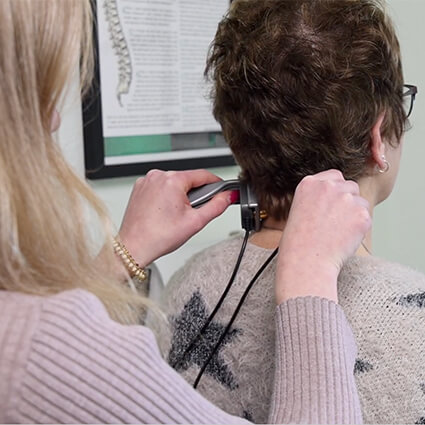
Chiropractic care is rooted in the understanding that the body is self-healing, self-regulating, and self-adapting. The nervous system is the master communication system behind all of that, and when there is interference in the spine through a subluxation, the body’s ability to adapt, respond, and heal is compromised.
Regular adjustments remove that interference so the brain and body can communicate the way they were designed to. The adjustment itself is not doing the healing. It is creating the conditions for the body to do what it already knows how to do.
When people start getting adjusted consistently and pairing that with the kind of awareness we are talking about here, things tend to shift in ways they were not expecting. Sleep improves. Energy comes back. A pattern that had been running for years starts to change. That is not a coincidence. The nervous system is involved in all of those processes, and when the communication clears, the whole system responds.
Where to start if this is resonating
If something in your body has been trying to get your attention, this is an invitation to get curious about it. A good place to begin is You Can Heal Your Life by Louise Hay. It is a book we return to regularly in the office, and it has genuinely changed how a lot of people understand the relationship between their inner world and what their body is showing them. If you’re in the Chippewa Falls area, stop in and borrow the book! We love to share it.
Beyond that, start paying attention. Notice when things show up and what was happening around that time. Notice the patterns. Notice what your body seems to be asking for. For example, you eat something and feel foggy for the rest of the afternoon, or you leave a conversation and realize your chest has been tight the entire time. That is real information, and learning to take it seriously is one of the most powerful things you can do for your long-term health.
And if you want support in understanding what your spine and nervous system are showing us, that conversation is always available here.