
 Why building strength at any age is one of the most important decisions you can make for your future.
Listen Now! Apple | Spotify | YouTube
The MRI image that will change how you think about aging
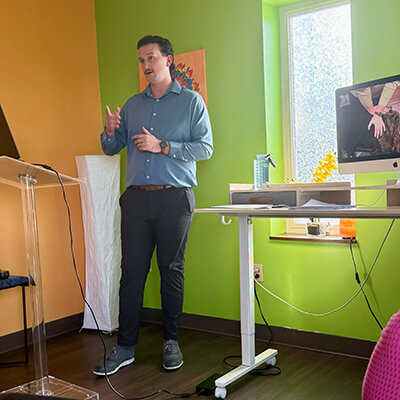
Dr. Jacob opened this talk with three MRI images of cross-sections of the quadrant muscles in three different people. He asked the room to guess who looked the healthiest.
The images were of a 40-year-old triathlete, a 74-year-old triathlete, and a 70-year-old who had not done any strength training. The 40-year-old and the 74-year-old looked nearly identical. The 70-year-old told a completely different story.
That is the use it or lose it principle in full view. An image of what consistent movement does, and what the absence of it does, to the human body over time.
Sarcopenia: the muscle loss most people don’t know is happening
Starting around age 30, the body loses somewhere between 3% and 8% of muscle mass per decade without resistance training. That process is called sarcopenia.
A qualitative meta-analysis published in 2004 states that both resistance training and aerobic exercise can counteract sarcopenia and the metabolic changes that come with it.
So, where did the idea come from that we just decline as we age and there is nothing to do about it? That story does not hold up in the research.
The number one reason people end up in assisted living.
It is not a diagnosis or a disease; it is the inability to stand up from a seated position. That single movement, a half squat, is the number one determining factor for whether someone moves into assisted living. When muscles are not being used and challenged over time, that movement becomes harder and eventually, impossible.
This is not meant to create fear. It is meant to make the case for why strength training is so important, and why starting now, at whatever age you are, is worth it.
A necessary conversation about GLP-1 medications
Dr. Jacob addressed this directly because it is nearly impossible to talk about muscle and metabolism without it. His approach was not to point fingers but to support true informed consent, something he believes people deserve when it comes to what they put in their bodies.
GLP-1 medications like Ozempic and Wegovy mimic the effects of glucagon, a hormone your body naturally produces to regulate blood sugar. Because they work so rapidly, the body cannot distinguish between fat loss and the loss of muscle and bone. The two go together.
A preliminary study presented at the American Academy of Orthopedic Surgeons’ 2025 annual meeting, based on 143,000 patient records across the United States, showed a 29% increased risk of developing osteoporosis and lower extremity fractures within five years among people taking GLP-1 medications compared to non-users. As a result, strength training has since been added to prescription protocols.
The body is designed to produce glucagon on its own. When a synthetic version is introduced consistently, the body tends to stop doing that work itself. That is why these are often called forever drugs. The FDA places a black box warning on them, which is the highest level of warning available on any drug.
How muscle and bone communicate
Bone is living tissue. It breaks down and rebuilds constantly through a process called remodeling. Osteoclasts break down old bone. Osteoblasts build new bone. The more osteoblast activity you stimulate, the stronger and denser your bones become.
What stimulates osteoblast activity? Muscle contraction.
Every time you move, lift, push, or pull, your muscles place what is called hormetic stress on the bones they attach to. Your body reads that signal: we need to be denser here. Without that signal, the body gradually scales bone strength down, and osteopenia or osteoporosis can follow.
Lean muscle mass also protects your bones in real time. Stronger muscles absorb force, so bones do not have to. They improve coordination and balance, which directly reduces the risk of falls, and falls are the leading cause of fractures in older adults.
Protein: more than a muscle conversation
Most people associate protein with muscle building, and that is accurate. Protein also makes up the flexible, resilient matrix of your bones, primarily through a structural protein called collagen. Without adequate protein, bones become more fragile even when calcium intake is sufficient.
The most consistent finding in the research for maintaining and building muscle mass is 0.82 grams of protein per pound of body weight per day, at any age. Base that number on your goal weight.
Whole food protein sources and approximate utilization rates:
- Pasture-raised eggs: ~48% utilization, the single best whole food protein source
- Red meat, poultry, wild-caught fish: ~32%
- Whey protein: ~18%, fine as a supplement, not a primary source
- Soy or pea protein: ~16%
Branched-chain amino acids (BCAAs) are incomplete amino acids, and the body does not use them. They are not the same as the nine essential amino acids your body requires and cannot produce on its own. If you are buying them, you can stop.
When possible, choose pasture-raised eggs, grass-fed and free-range meats, and wild-caught fish. Grain-fed animal products are more inflammatory and less nutrient-dense. In Wisconsin, better sources are more accessible than in most places. Use that.
What strength training should look like
The goal is training for your life. At some point, the fitness world shifted toward training individual muscle groups for appearance. That approach does not build long-term resilience, bone health, or the ability to keep up with your grandkids, get through a workday, or stay out of assisted living.
Five variables that matter most:
1. Exercise selection. Compound movements that involve multiple muscle groups: squats, hip hinging, pushing, pulling, core stabilization, and stability work. These give the best return for both muscle and bone health.
2. Intensity. You should be able to do one to three more reps at the end of most sets. Training to failure is not necessary for building lean muscle mass, and it works against the adaptive process.
3. Progressive load. Your body adapts. If you do the same thing every time, your body stops responding to it. Add weight, change reps, or focus more intentionally on a controlled range of motion over time.
4. Frequency. Two to five sessions per week, depending on your goals and experience. If you have never trained consistently, starting at two days and building from there is smarter than burning out at five.
5. Recovery. Dr. Jacob called this the most important variable in the entire talk. Sleep is where your body regenerates at the cellular level. For men, 7 to 8 hours. For women, 8 to 10 hours. Not time in bed with a phone, dedicated, lights-out sleep. Half your body weight in ounces of water daily supports tissue repair as well.
Signs you are progressing:
- Daily tasks feel less effortful week to week
- Recovery between sessions gets faster
- Posture and stability improve
- Body composition shifts
Where chiropractic fits into all of this
Dr. Jacob closed with a quote from B.J. Palmer, the developer of modern chiropractic:
“Medicine is the study of disease and what causes man to die. Chiropractic is the study of health and what causes man to live.”
Chiropractic care is not designed to instantly make you feel better. It is designed to instantly make you heal better.
When subluxations are corrected and the spine is adjusted, the nervous system communicates more efficiently with everything: muscles, bones, organs, tissues. That improved brain-to-body connection supports muscle adaptation, bone remodeling, recovery, and your body’s ability to self-regulate.
Dr. Jacob put it simply: imagine a restaurant where none of the staff have headsets. No one can communicate, and nothing functions the way it should. Your nervous system is the headset. The adjustment is what keeps the signal clear.
When your nervous system is communicating well, you move better, recover faster, and stay more connected to what your body is telling you.
Where to begin
Dr. Jacob shared three strength training tracks at this talk, one for beginners, one intermediate, and one for those ready to train five days a week. All three can be done without a full commercial gym.
A few places to start that do not require changing everything at once:
- Check your protein intake against the 0.82 grams per pound goal
- Add one compound movement to your week
- Honor your sleep the way you would any other health commitment
- Get adjusted consistently, not only when something hurts
If you have questions about the strength training programs, reach out to Dr. Jacob directly.
If you are not yet a practice member here, we have initial evaluations available.
More conversations like this one are on our YouTube channel. Subscribe so you know when the next one drops.