
 The 3 main stressors that cause more tension in your body.
And how to release it so you can finally feel at ease in your body.
Listen Now! Apple | Spotify | Youtube
The 3 things stressing your spine (and most people only think about one)
When practice members come into the office, and we start talking about how they’re feeling and why they might feel out of balance, the conversation almost always starts the same way.
“I slipped and fell.” “I strained something.” “I think it’s from my desk.”
Physical events, things you can point to. And those absolutely are important, but they are only one piece of what we call the 3 Ts: Thoughts, Traumas, and Toxins. Most people have the trauma piece on their radar, but the other two get far less attention.
That is exactly what we dive into in this conversation.
How stress and negative thought patterns affect your spine and nervous system.
Your nervous system does not distinguish between a car accident and a news cycle that sends you into a spiral. To your body, stress is stress, and it responds accordingly.
When your nervous system is flooded with negative input, whether that is a relationship that is draining you, a high-stress job, or an hour of news before bed, your spine and nervous system will hold onto it. Everything in your body can tense, and over time, that guarded state becomes your baseline.
For example, one of the simplest things you can do is turn the news off earlier in the evening. Not forever, and not because you do not care about what is happening in the world, but because your body needs windows of time where it is not absorbing rapid-fire negativity. Even just a week of that one shift can create a noticeable change in how your system processes and recovers.
This is not only true for adults. Lona shared a moment from the previous week, picking up her child who had spent the afternoon at a relative’s house, with the news running in the background. He came home asking if kids were going to die because of what he heard on the news. That is the nervous system of a child absorbing something it was never meant to carry, and it is a real reminder of how much is circulating in the environments we spend our time in.
Another example could be simply noticing when you have a negative thought, then choosing to react differently next time, or reframing the negative thought.
Synthetic fragrance, everyday toxins, and what they’re doing to your hormones.
When most people hear the word “toxins,” they think food. And yes, what you eat matters enormously. But toxins also include what you are surrounded by every day.
Artificially scented products are a big one that most people never think about. Synthetic fragrances found in conventional candles, dryer sheets, air fresheners, laundry detergents, and perfumes are hard on the body because they are not natural compounds your system knows how to process, and they can interfere with hormone function over time. If you want to start somewhere, look for products that use essential oils or are labeled fragrance-free. It is a smaller ask on your body than something designed in a lab.
A few easy swaps worth knowing about:
- Laundry detergent: Branch Basics, Molly’s Suds
- Candles: Look for 100% beeswax or soy with essential oils instead of synthetic fragrance
- Air freshener: A diffuser with essential oils does the same job without the chemical load
- Perfume: Try a roll-on made with essential oils or shop from brands that disclose every ingredient
The same principle applies to what you are eating. Diet culture has spent decades telling people not to trust their own body, that they need a set of external rules to override their own hunger and fullness signals. But your body, when given a chance, knows what it needs. Intuitive eating is a return to something your body already understands how to do. The difficulty is that so many people have been disconnected from those internal signals for so long that listening feels unfamiliar at first.
That disconnection is part of what chiropractic care helps address. When the brain-to-body connection becomes clearer through regular adjustments, people often begin noticing things they had stopped noticing altogether: hunger cues, energy patterns, what actually feels good in their body versus what they had simply learned to live with.
If you’d like to learn more about intuitive eating, be sure to ask Dr. Kami next time you’re in for an appointment. The book below is also a great resource to start with!
Intuitive Eating, 4th Edition by RDN Evelyn Tribole, MS and RDN Elyse Resch, MS
There is a workbook as well that goes along with the book above!
Small daily habits that support a healthier spine and nervous system.
Something that comes up often once people start learning about all of this is that it can feel completely overwhelming. Like you have to change everything immediately: organic food, a detoxed home, no news, perfect sleep, clean products, daily movement, all of it at once.
That is not how lasting change works, and honestly, that pressure is its own stressor on your nervous system.
There is a concept from the book Power vs. Force by David R. Hawkins that speaks directly to this. Think about what happens when you multiply a very small decimal fraction by itself over and over again. At some point, a calculator has to round the number, and that rounding error compounds with every single calculation until the result is far from the actual answer. The same thing happens in reverse with positive change. The smallest shift in your daily habits, made consistently over time, creates a ripple effect that compounds far beyond what it looks like on any given day.
Pick one thing and start there:
- Drink a glass of water before you look at your phone in the morning
- Put your phone in another room 30 minutes before bed
- Get adjusted consistently instead of only when something hurts
- Swap one synthetic fragrance product when you run out of it
- Move your body for 20 minutes a day
- Sit outside for 10 minutes without a screen
- Switch your cleaning products one by one when you run out of something (Vinegar can be used for almost everything!)
Any one of those choices, made consistently, moves you further than a complete overhaul that burns out in three weeks. None of us are doing this perfectly, and we are in it alongside you.
What builds real resiliency is becoming your own witness: noticing that you made a certain choice and felt the difference, and letting that awareness guide the next decision. That is how the body learns.
What is sympathetic dominance, and can your nervous system actually change?
A lot of people come in and describe having simply gotten used to feeling a certain way. Tight all the time, wound up, a knot in their throat, a constricted chest, consistent stomach aches. They share it almost as if that is just who they are and how it’s always been.
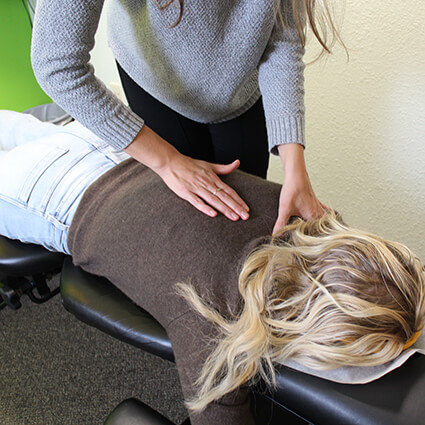
When someone has been living in a chronic stress state, what we call sympathetic dominance, it has become their baseline. It feels familiar, and over time, it can feel permanent. But the nervous system is adaptable, and it responds to the input it receives. When subluxations are corrected and the communication between the brain and body is restored through consistent chiropractic care, the system can genuinely shift.
We have watched practice members who spent years in that wound-up state begin to feel what it means to be regulated, and most of the time, they cannot believe they lived any other way for as long as they did.
What chiropractic adjustments actually do for your brain-to-body connection.
Rather than asking, “How do I fix this?” consider asking, “What is my body responding to?”
Your body is never working against you. When something keeps showing up, the same tight spot, the same recurring tension, the same symptom that comes back, that is information worth paying attention to. It is your body communicating, doing its best to protect you and get your attention at the same time.
The goal of chiropractic care is to remove interference so that communication between the brain and the body can function as it was designed. Small decisions made consistently, real awareness of what you are putting into and around your body, and a spine and nervous system that is regularly checked and adjusted — these things together create a very different long-term trajectory. What happens after the interference is removed is the body doing exactly what it already knows how to do.
For example, if you eat a certain something and feel sluggish and foggy for the rest of the afternoon, or you leave a conversation and notice your shoulders are up by your ears and your stomach feels tight. Or, you stay up past the point your body was asking for sleep and wake up the next day, unable to think clearly. That is your body giving you real-time information, and the more you start to listen to it rather than override it, the more that relationship with your own system starts to shift.
You do not have to figure this out alone
If you recognize some of these patterns in your own life, that is a good place to start. We are here to walk alongside you, to help you understand what your body is showing you and what your next step could look like.
You can schedule an appointment here: https://www.cookchirocenter.com/contact-us/
And if you are not quite ready for that, start by noticing. Notice when the tension shows up, what was happening that day, what your body might be trying to communicate. That awareness alone begins to shift things.
If this conversation was helpful, share it with someone in your life who might need to hear it. You can find more conversations like this on our YouTube channel, where we cover the same things we are seeing and talking about in the office every day. Subscribe so you know when a new episode drops.